
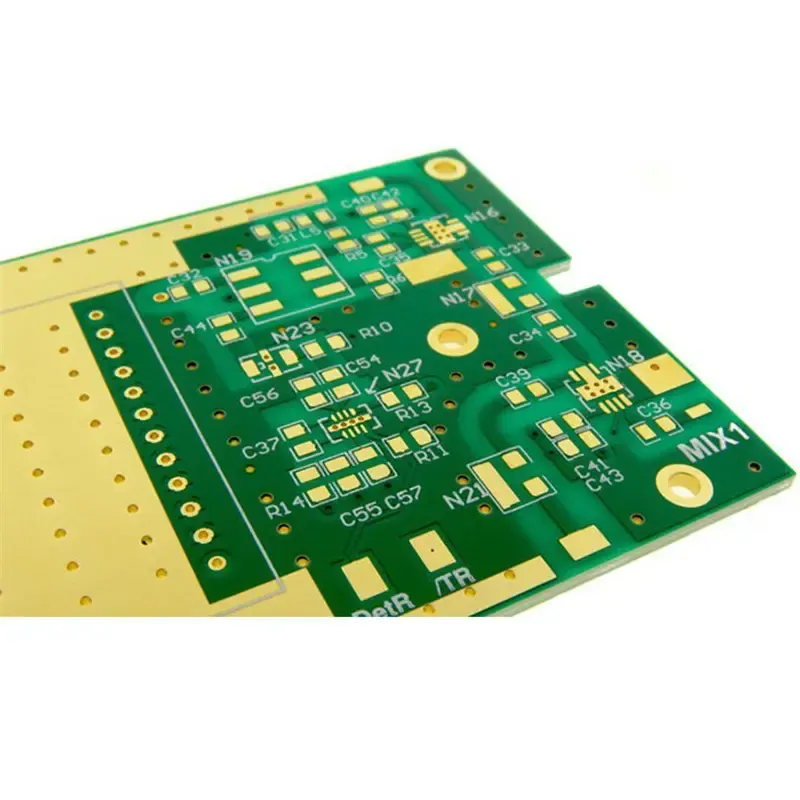
Respuesta directa
To find the right RF PCB manufacturer, evaluate engineering capability, process control, and supply chain resilience—not just price. A qualified supplier must demonstrate experience with your frequency range, controlled impedance testing, and specialty laminates. Ask for DFM feedback samples, impedance test reports, and material sourcing documentation before sending your RFQ. The right partner reduces schedule risk and rework cost.
Lo que realmente está intentando reducir el riesgo
When you evaluate an RF PCB manufacturer, you are not buying copper and fiberglass. You are buying certainty that a high-frequency signal will arrive at its destination with acceptable loss and no unintended radiation. The real risk is not the board itself; it is the unknown behavior of materials, tolerances, and processes that you cannot see from a quote.
RF boards fail in predictable ways. Impedance mismatches occur when the dielectric constant of the laminate shifts from the datasheet value. Signal integrity degrades when copper roughness increases insertion loss. Via transitions create reflections when the return path is interrupted. A manufacturer that understands these failure modes can prevent them. One that only follows a generic multilayer process will produce boards that test within DC continuity but fail in the application.
Your job before sending an RFQ is to define the electrical and mechanical constraints precisely. Specify the stackup, laminate part numbers, copper weight, surface finish, and target impedance for every controlled net. Include the frequency range and the acceptable insertion loss budget. The more complete your specification, the less room the manufacturer has to make assumptions that later become change orders or rework.
Capability Signals That Matter for RF
Material Experience and Sourcing
RF performance depends heavily on laminate selection. Standard FR-4 has a dielectric constant that varies with frequency and resin content, making it unsuitable for tight impedance control above roughly 1 GHz. Specialty laminates such as Rogers, Isola, or Taconic offer stable dielectric constants and lower loss tangents, but they behave differently in fabrication.
Ask the supplier which laminates they process regularly. A manufacturer that only occasionally runs Rogers material will have less predictable etch factors and impedance yields. Ask about their material sourcing relationships. Specialty laminates often have long lead times or allocation issues. A supplier with an established supply chain can secure material faster than one that orders per job. This connects directly to broader laminate supply chain risk, so review how your supplier plans for material shortages before you commit.
Controlled Impedance Testing
Controlled impedance is not a design option; it is a manufacturing requirement. The manufacturer must fabricate test coupons on the panel and measure impedance using time-domain reflectometry (TDR) or a vector network analyzer (VNA). Ask which method they use, how many coupons per panel they test, and what tolerance they hold.
A standard tolerance is ±10%, but RF designs often require ±5% or tighter. Tighter tolerances require more process control and more test coupons. Ask whether the supplier can tune the etch process or adjust dielectric thickness to bring impedance back into spec if the first test fails. Some manufacturers only test and reject; better ones adjust and rework.
DFM Calidad de retroalimentación
A strong RF PCB manufacturer provides detailed design for manufacturability (DFM) feedback before production. This feedback should address stackup symmetry, copper distribution, via aspect ratios, and impedance-controlled structure feasibility. If the supplier returns a DFM report that only checks for missing drill files, they lack RF-specific engineering depth.
Send the same design to two or three suppliers and compare their DFM questions. A supplier that asks about your reference plane spacing, return via placement, or solder mask over controlled impedance structures demonstrates real RF knowledge. One that asks only about board thickness and copper weight is treating your design like a standard digital board.
Factores de costo y programación que debe comprender
Stackup Complexity
The number of layers, the choice of laminate, and the mix of materials drive cost more than board area. A two-layer RF board on Rogers material costs more per square inch than a four-layer FR-4 board because the material cost dominates. Hybrid stackups that combine FR-4 cores with RF-grade outer layers add lamination steps and increase the chance of warpage.
Copper weight also matters. Thicker copper increases etch factor variation, which changes trace width and impedance. If your design requires 2 oz or heavier copper on outer layers, expect tighter process control requirements and potentially lower impedance yields.
Selección de acabado superficial
Surface finish affects both cost and RF performance. ENIG (electroless nickel immersion gold) is common but the nickel layer adds insertion loss at high frequencies. ENEPIG (electroless nickel electroless palladium immersion gold) offers better wire bonding and reduced loss. Immersion silver and OSP (organic solderability preservative) are cheaper but have shelf-life and handling constraints.
For RF boards above 10 GHz, finish choice becomes a performance variable, not just a cost variable. Ask the manufacturer how their finish process affects copper roughness and whether they can provide loss data for the finish they recommend.
Lead Time Variability
RF PCB lead times fluctuate with material availability and production load. Specialty laminates may require weeks of lead time if the supplier does not stock them. Controlled impedance testing adds inspection time, especially if first-pass yield is low and rework is needed.
Ask the supplier about their current material stock position and their typical lead time for your laminate choice. Get lead time commitments in writing. A supplier that quotes a standard lead time without checking material availability is creating schedule risk. For a deeper look at how laminate and resin supply chains affect planning, see how to plan PCB laminate and resin supply chain risk for lead time and cost.
Supplier Qualification Matrix
Use the following table to compare RF PCB suppliers on the factors that actually predict success. Score each supplier from 1 to 5, with 5 being the strongest capability.
| Qualification Factor | What to Review | Por qué es importante |
|---|---|---|
| RF material experience | Number of RF laminates processed, frequency range supported | Predicts impedance yield and process tuning ability |
| Impedance testing capability | TDR or VNA method, coupon count, tolerance hold | Confirms electrical performance, not just continuity |
| DFM engineering depth | Quality of questions and feedback on stackup, vias, reference planes | Identifies design issues before fabrication, not after |
| Material sourcing position | Stock levels, supplier relationships, allocation risk | Determines lead time reliability and schedule risk |
| Inspection and test methods | AOI, flying probe, microsectioning, impedance verification | Confirms physical and electrical quality |
| Certifications and process controls | ISO, IPC membership, documented process specifications | Baseline quality system, not a substitute for review |
| Assembly capability | SMT experience with RF components, reflow profile control | Reduces handoff risk if you need PCBA services |
| Communication responsiveness | RFQ response time, question quality, engineering access | Predicts collaboration quality during production |
Score suppliers before sending an RFQ. This forces you to evaluate capability systematically rather than reacting to the lowest quote.
What to Include in Your RFQ Package
Required Files
Send Gerber files in RS-274X or ODB++ format, a drill file, and a fabrication drawing. The fabrication drawing must include the complete stackup with material part numbers, dielectric thickness, copper weights, and target impedance values for every controlled net. Include the impedance test requirements, including which layers and nets require testing and the acceptable tolerance.
If you are requesting assembly, include a BOM with manufacturer part numbers, reference designators, and lifecycle status. Mark any components that are not authorized for alternate sourcing. Include moisture sensitivity level (MSL) ratings for all components so the supplier can plan storage and baking steps per J-STD-033.
Design Notes
Add a design note explaining the RF intent. State the operating frequency, the insertion loss budget, and any critical via transitions or reference plane requirements. This helps the manufacturer understand what matters electrically, not just geometrically.
Include any special requirements for solder mask. Solder mask over controlled impedance traces changes the effective dielectric constant and can shift impedance. If your design requires mask over RF traces, specify the mask type and thickness. If not, request mask removal over critical RF areas.
Approval Steps
Define the approval process in your RFQ. Specify when you expect DFM feedback, when you will approve the final stackup, and when you need impedance test reports. A clear approval workflow prevents production from starting before you have validated the design against the manufacturer's process capability.
Questions to Ask Before You Commit
Engineering Questions
Ask how the supplier handles impedance failures. Do they rework, scrap, or ship with a deviation request? A supplier that ships out-of-spec boards with a "best effort" note is not acceptable for RF work.
Ask about their etch factor assumptions for your copper weight and trace geometry. Etch factor determines the difference between the top and bottom trace width, which directly affects impedance. A supplier that cannot articulate their etch factor for your stackup lacks process control.
Ask how they manage via transitions. Plated through-hole vias in RF paths create parasitic capacitance and inductance. Ask whether they recommend back-drilling for high-frequency via stubs and whether they have back-drilling capability.
Supply Chain Questions
Ask about component lifecycle status if you are requesting assembly. Parts in "last time buy" or "end of life" status create NCNR (non-cancelable, non-returnable) risk. Ask whether the supplier can source approved alternates and how they manage counterfeit risk in the supply chain.
Ask about their AVL (approved vendor list) for RF components. A supplier with a limited AVL may substitute components that change your RF performance. Require written approval before any substitution.
Ask about MSL handling procedures. RF components such as MMICs and SAW filters are often moisture-sensitive. A supplier that does not follow J-STD-033 baking and storage requirements risks delamination and internal cracking during reflow. This is a hidden assembly risk that can be evaluated before production.
Inspection and Test Questions
Ask what inspection methods they use for RF boards. Automated optical inspection (AOI) catches etch defects but does not verify impedance. Flying probe testing verifies continuity and isolation but does not measure high-frequency performance. Microsectioning verifies plating quality and layer registration but is destructive and sampled.
Ask how they verify impedance on production boards, not just coupons. Coupon testing is standard, but coupons are not identical to the production board. Some suppliers offer in-circuit impedance testing on critical nets. Ask whether this is available and what it costs.
Practical Risk Review Steps
Before you commit to a supplier, run a structured risk review. First, verify that the supplier's process capability matches your stackup complexity. A supplier that handles standard multilayer boards well may struggle with hybrid RF stackups that combine different laminate types.
Second, review their material sourcing plan. Ask for current lead times on your specific laminate part numbers. If the supplier cannot confirm material availability, your schedule is at risk. This is especially important for Rogers or other specialty materials that may have allocation constraints.
Third, evaluate their assembly capability if you need PCBA services. RF assembly requires careful reflow profiling because the thermal mass of RF components varies. A supplier that cannot control reflow profiles risks solder joint defects and component damage. Review their SMT assembly risk assessment to understand how they handle lead time and pricing trends.
Fourth, compare your supplier options using the qualification matrix. A lower-cost supplier that cannot hold impedance tolerance will cost more in rework and delayed schedules than a higher-cost supplier that gets it right the first time. For a broader view of supplier selection, review the essential tips for custom PCB supplier selection. If your design is a double-sided board, check how to choose the right double-sided PCB manufacturer for your specific requirements.
> Practical note: When comparing RF PCB suppliers, ask for a sample impedance test report from a recent RF job. Review the report for coupon placement, test method, and measured values versus target. A supplier that cannot produce a clean, complete test report will not produce reliable RF boards.
Final RFQ Checklist
Before sending your RFQ, confirm that you have completed the following steps:
- Defined the stackup with material part numbers, dielectric thickness, and copper weights
- Specified target impedance and tolerance for every controlled net
- Included frequency range and insertion loss budget in the design notes
- Confirmed surface finish selection with RF performance in mind
- Verified that Gerber, drill, and fabrication drawing files are complete
- Included BOM with lifecycle status and MSL ratings for assembly
- Defined approval workflow and expected DFM feedback timing
- Identified which suppliers to qualify using the evaluation matrix
- Confirmed material availability and lead time expectations in writing
A complete RFQ does not guarantee a perfect supplier, but it eliminates the ambiguity that causes quote changes, schedule slips, and impedance failures. The time you invest in specification and supplier evaluation is the cheapest insurance you can buy for an RF PCB program.
> Engineering handoff note: How to Qualify HDI PCB Suppliers for Lead Time, DFM, and RFQ Risk, How to Plan PCB Laminate and Resin Supply Chain Risk for Lead Time and Cost, and How to Evaluate SMT Assembly Risk from Lead Time and Pricing Trends before the release package is frozen.
> Also compare Custom PCB Supplier Selection: Essential Tips for Success and Double Sided PCB Fabrication: How to Choose the Right Manufacturer before locking the quote scope.