
Direkte Antwort
Isola PCB material refers to a family of high-performance laminate systems used when standard FR4 cannot meet signal integrity, thermal, or reliability requirements. For most designs, Isola 370HR is the sensible default because it improves thermal performance over FR4 without a major cost jump, while FR408HR, IS415, IS620, and IS680 serve progressively higher-speed and lower-loss applications. Your choice should be driven by target impedance tolerance, insertion loss budget, and operating environment, not by brand preference.
---
When to Use Isola 370HR as Your Default Laminate
Isola 370HR is the most common starting point for designers who need better reliability than standard FR4 but do not yet require low-loss materials. It is a high-Tg, high-reliability epoxy laminate that performs well in multilayer boards, automotive electronics, industrial controls, and networking equipment operating up to a few GHz.
The key engineering difference between 370HR and standard FR4 is the glass transition temperature (Tg). 370HR typically offers a Tg around 170°C, which means the material maintains its mechanical and electrical properties better during lead-free reflow and in high-temperature operating environments. This matters for boards that will see repeated thermal cycling, such as power electronics or modules mounted near heat sources.
For impedance-controlled designs, 370HR provides a stable dielectric constant (Dk) around 4.0 to 4.2 depending on the glass weave and resin content. This is predictable enough for most single-ended and differential pairs up to a few GHz. If your design has tight impedance tolerances, such as ±5% on 100-ohm differential pairs, you should still specify the exact 370HR variant and glass weave in your stackup.
Use 370HR when your signal speeds are moderate, your layer count is between 4 and 16, and your operating environment includes thermal stress. If your design is a simple two-layer board with no impedance requirements, standard FR4 is likely more cost-effective, and 370HR would be over-specification.
---
Understanding the Isola Material Families and Their Tradeoffs
Isola groups its laminates by performance level, and understanding this grouping helps you match the material to your signal integrity budget.
Mid-Loss Materials: FR408HR
FR408HR is the next step up from 370HR. It offers a lower dissipation factor (Df), typically around 0.008 to 0.010 at 1 GHz, which reduces insertion loss on longer traces. This material is appropriate for 10 Gb/s serial links, backplanes, and high-speed digital systems where signal integrity starts to become a limiting factor.
The Dk of FR408HR is slightly lower than 370HR, usually around 3.6 to 3.8. This means your trace widths will be slightly wider for the same target impedance, which can improve manufacturability and reduce copper surface roughness effects. However, FR408HR costs more than 370HR, so you should only use it when your loss budget actually requires it.
Low-Loss Materials: IS415 and IS620
IS415 and IS620 are low-loss materials designed for applications where insertion loss is critical. IS415 is a hydrocarbon-based laminate with a Df around 0.004, while IS620 offers even lower loss with a Df around 0.002 to 0.003. These materials are used in high-speed digital systems above 25 Gb/s, RF front-ends, radar systems, and satellite communications.
The tradeoff with low-loss materials is not just cost. They often have different coefficients of thermal expansion (CTE) compared to standard FR4, which can create reliability concerns in multilayer boards that mix material types. They also require more careful handling during drilling and plating because the resin systems are more brittle than standard epoxy.
Very Low Loss: IS680
IS680 is Isola's highest-performance laminate for extreme high-speed and RF applications. It offers a Df below 0.002 and very stable Dk across frequency and temperature. This material is appropriate for millimeter-wave applications, 5G infrastructure, and high-end test equipment.
The practical issue with IS680 is that not all PCB manufacturers have experience processing it. It requires controlled drilling parameters, plasma desmear, and careful lamination cycles. Before you design with IS680, confirm that your manufacturer has processed this material successfully on similar stackups.
---
Engineering Principles Behind Material Selection
The decision between Isola grades comes down to three engineering variables: dielectric constant (Dk), dissipation factor (Df), and coefficient of thermal expansion (CTE).
Dielectric Constant and Impedance Control
Dk determines the propagation velocity of signals and directly affects trace impedance. For a given stackup, a higher Dk means narrower traces for the same target impedance. Narrower traces increase conductor loss and make impedance control more sensitive to etch tolerance.
When you specify an Isola material, you must also specify the glass weave style. Standard E-glass weaves can create Dk variations across the board surface due to resin-rich and glass-rich areas. This becomes critical for high-speed designs where impedance tolerance is tight. Isola offers spread-glass versions of many materials, which reduce this variation but add cost.
Dissipation Factor and Insertion Loss
Df is a measure of how much signal energy is lost as heat in the dielectric material. Lower Df means less loss per unit length of trace. For a 10-inch trace at 10 Gb/s, the difference between FR408HR and IS620 can be several decibels of insertion loss, which can mean the difference between a closed eye diagram and a failing link.
The loss budget for your design should be calculated before you choose the material. If your total channel loss budget is 20 dB and your connectors and vias consume 10 dB, you have 10 dB for the PCB traces. Divide that by your total trace length to get the maximum acceptable loss per inch, then select the material that meets that number.
Thermal Expansion and Reliability
CTE mismatch between copper, glass, and resin is a primary cause of via cracking and pad lifting under thermal cycling. Isola 370HR has a lower CTE than standard FR4, which improves reliability in multilayer boards. Low-loss materials like IS620 often have different CTE behavior, so you need to verify that the material is compatible with your board thickness and via structure.
For boards that will experience repeated thermal cycling, such as automotive or aerospace applications, the material's Z-axis expansion is critical. High-Tg materials like 370HR reduce Z-axis expansion, which lowers the stress on plated through-holes and vias.
---
Manufacturing Constraints and Fabrication Considerations
Choosing an Isola material is not just an electrical decision; it also affects how your board is fabricated. Different materials require different drilling parameters, lamination cycles, and surface preparation.
Drilling and Hole Quality
Low-loss materials with hydrocarbon or PTFE-based resins are softer than standard epoxy glass. This means drill bits wear differently, and hole wall quality can vary. If your design has many small vias, such as 0.2 mm or smaller, you should confirm that your manufacturer can achieve acceptable hole wall quality on the chosen material.
For multilayer boards, the lamination cycle must be matched to the material's resin system. Mixing different material types in the same stackup, such as using IS620 for outer layers and 370HR for inner layers, requires careful process control to avoid resin flow issues and delamination.
Surface Finish Compatibility
The chosen Isola material must be compatible with your required surface finish. ENIG, ENEPIG, and immersion silver all have different processing temperatures and chemical exposures. Most Isola materials work with standard finishes, but you should verify compatibility, especially for low-loss materials that may absorb chemicals differently.
Rigid-Flex Considerations
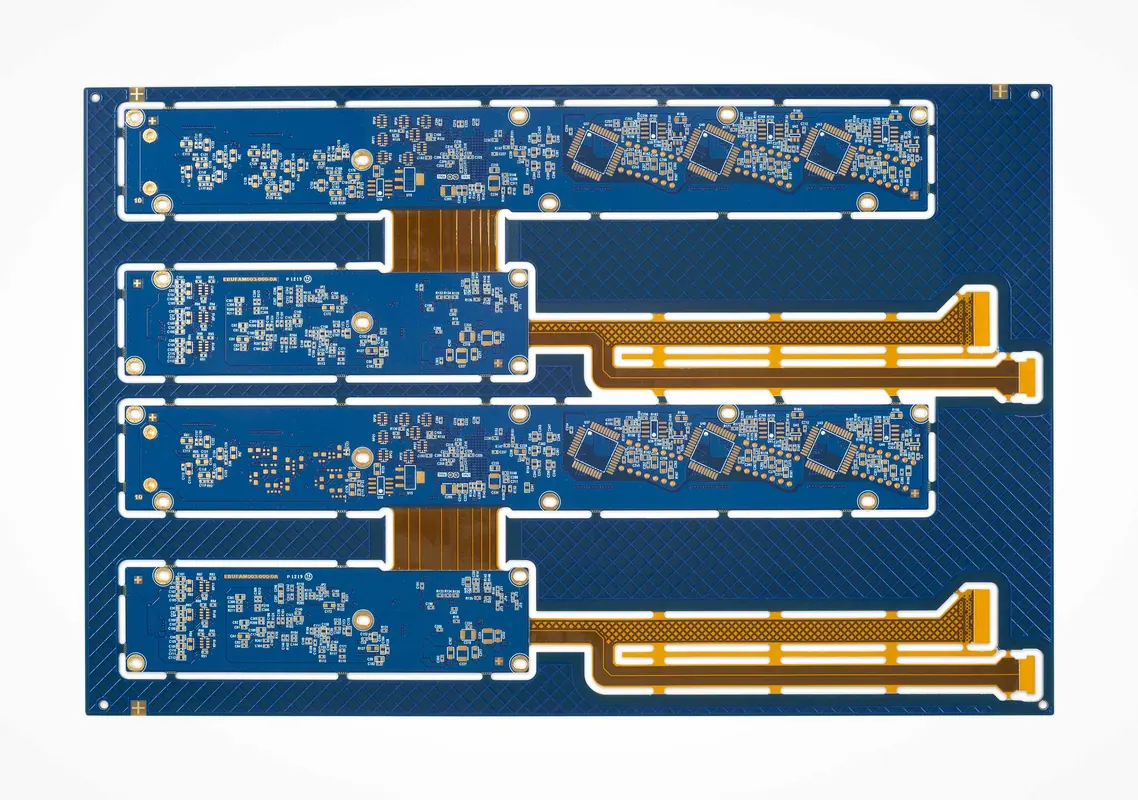
If your design is a rigid-flex board, material selection becomes more complex. Flex materials are typically polyimide-based, and the rigid sections may use Isola materials. The transition zone between rigid and flex layers is a common failure point, so the material combination must be carefully specified.
For guidance on the flex side of the stackup, review the Flex PCB Manufacturing Process: Materials Selection, Etching, & Lamination article, which covers the material constraints specific to flexible circuits.
---
Häufige Fehler, die während der DFM-Überprüfung zu Nacharbeit führen
Several recurring mistakes appear when designers submit Isola-based stackups for manufacturing review. Avoiding these will save you at least one revision cycle.
Specifying the Wrong Grade for the Application
The most common mistake is using a low-loss material like IS620 when a mid-loss material like FR408HR would meet the loss budget. This adds unnecessary cost and may introduce fabrication complications. Calculate your loss budget first, then select the minimum material grade that meets it.
Forgetting to Specify Glass Weave
Specifying "Isola FR408HR" without a glass weave style leaves the manufacturer to choose, and their default may not meet your impedance tolerance. If you need tight impedance control, specify the glass weave style, such as 3313 or 2116 spread glass, in your stackup.
Inconsistent Material Naming
Isola has multiple product lines and variants. Writing "IS415" when you mean "IS415A" or specifying a material that has been superseded can cause confusion. Use the full Isola part number from the datasheet and include it in both the stackup and the fabrication notes.
Ignoring Copper Roughness Effects
At high frequencies, copper surface roughness contributes significantly to conductor loss. A low-loss dielectric paired with standard electrodeposited (ED) copper may not achieve the loss performance you expect. For high-speed designs, specify low-profile or reverse-treated copper, and understand that this affects the material cost.
Not Verifying Material Availability
Some Isola grades are less common than others. If you specify a niche material, your manufacturer may need to order it, which adds lead time. Ask about availability before you finalize the design.
---
Isola Material Selection Decision Table
Use the following table as a starting point for selecting the appropriate Isola grade based on your design requirements.
| Material | Dk (approx.) | Df (approx.) | Typical Application | Cost Relative to FR4 |
|---|---|---|---|---|
| 370HR | 4.0–4.2 | 0.010–0.012 | General multilayer, automotive, industrial | Low |
| FR408HR | 3.6–3.8 | 0.008–0.010 | 10 Gb/s backplanes, high-speed digital | Moderate |
| IS415 | 3.4–3.6 | 0.004–0.005 | 25 Gb/s links, RF front-ends | High |
| IS620 | 3.2–3.4 | 0.002–0.003 | 56 Gb/s, radar, satellite | Very High |
| IS680 | 3.0–3.2 | <0.002 | Millimeter-wave, 5G, test equipment | Highest |
This table provides approximate values. Always refer to the current Isola datasheet for the specific material variant you plan to use, as Dk and Df can vary with resin content, glass weave, and frequency.
---
What to Verify in Your Fabrication Data
Before you send your Gerber files to a manufacturer, review the following items in your fabrication package.
Stackup Specification
Your stackup must specify the exact Isola grade, dielectric thickness, and copper weight for each layer. Do not rely on a generic "FR4" note if you intend to use Isola material. The manufacturer will quote based on what you specify, and a generic note may result in a different material being substituted.
Impedance Requirements
Clearly state the target impedance, tolerance, and reference layers for each controlled impedance net. Include the test method, such as TDR or impedance coupon testing, and the acceptance criteria. This information allows the manufacturer to build test coupons on the same panel and verify performance.
Fabrication Notes
Include the material grade, glass weave, and any special processing requirements in your fabrication notes. If you require thermal stress testing or controlled impedance testing, state that explicitly.
Material Traceability
Ask your manufacturer for a material certificate of conformance that verifies the Isola grade, lot number, and date code. This is especially important for high-reliability applications where material traceability is required for qualification.
---
What to Ask Your PCB Manufacturer About Isola Material
When you send your design out for fabrication, ask these questions to avoid surprises.
Do You Have This Material in Stock?
Material availability varies by manufacturer and region. If your chosen Isola grade is not in stock, you may face extended lead times. Ask before you commit to a delivery schedule.
Can You Provide Impedance Test Coupons?
Impedance test coupons must be fabricated on the same panel as your production boards to be meaningful. Confirm that your manufacturer can build and test coupons that match your stackup and impedance requirements.
What Is Your Experience With This Material?
Some Isola grades, especially low-loss materials, require specialized processing. Ask about the manufacturer's experience with your specific material, particularly for multilayer or rigid-flex designs. For rigid-flex, also review the material selection guidance in the How to Choose the Right Material for Your Flexible LED PCBs article.
Is the Material Compatible With My Surface Finish?
Confirm that the chosen Isola material works with your required surface finish and assembly process. This is especially important for low-loss materials that may have different chemical resistance or moisture absorption characteristics.
---
Practical Review Checklist for Isola Material Selection
Before finalizing your design, run through this checklist.
- Calculate your insertion loss budget and select the minimum Isola grade that meets it.
- Specify the exact Isola grade, glass weave, and copper type in your stackup.
- Confirm that the material's Dk is compatible with your target impedance and trace width.
- Verify that the material's Tg and CTE are suitable for your operating environment and assembly process.
- Check that the material is compatible with your required surface finish.
- Confirm that your manufacturer has the material in stock and has experience processing it.
- Include impedance test coupon requirements in your fabrication notes.
- Request a material certificate of conformance for traceability.
For a broader perspective on material selection, compare Isola against other laminate options. The FR4 vs Rogers PCB Material: Which One Should I Choose for My Products? article covers the tradeoffs between standard FR4 and high-frequency laminates, while the How Do You Select RF PCB Material and the Most Commonly Used Types? article addresses RF-specific selection criteria.
If you are new to PCB design, review the PCB Design Guidelines for Beginners: Rules and DFM Checklist to ensure your layout is manufacturable before you invest in premium materials.
---
FAQ
What is the default Isola PCB material for most designs?
For standard digital and analog PCBs, Isola 370HR is a common default because it offers better thermal performance than standard FR4 while remaining cost-effective. It is suitable for most applications up to a few GHz, but for high-speed signals above that, you should consider mid-loss or low-loss grades like FR408HR or IS415.
When should I choose a higher-performance Isola material like IS620 or IS680?
Choose low-loss Isola materials like IS620 or IS680 when your design requires very low insertion loss, such as in high-speed digital backplanes, RF front-ends, or radar systems. These materials have a lower dissipation factor (Df) but are more expensive and may require special handling during fabrication, so they are not the right choice for cost-sensitive, lower-frequency designs.
What should I verify in my fabrication data when using Isola material?
Verify that the stackup specifies the exact Isola grade, dielectric thickness, and copper weight for each layer. Also check that the impedance requirements are clearly stated, including the target impedance, tolerance, and the reference layers. Ensure your fabrication notes include the material grade and any special processing requirements, such as controlled impedance testing or thermal stress testing.
What should I ask my PCB manufacturer about Isola material?
Ask if they have the specific Isola grade in stock and if they can provide a material certificate of conformance. Also ask about their experience with that material, especially for multilayer or rigid-flex designs, and whether they can provide impedance test coupons on the same panel. Finally, confirm that the material is compatible with your required surface finish and assembly processes.
How does Isola material compare to Rogers material?
Isola materials are generally more cost-effective than Rogers laminates for high-speed digital applications, while Rogers materials are often preferred for RF and microwave designs with very specific Dk requirements. The choice depends on your frequency range, loss budget, and cost constraints. For a detailed comparison, refer to the FR4 vs Rogers material guide linked earlier in this article.
Can I mix Isola materials with standard FR4 in the same stackup?
Yes, hybrid stackups are common, but they require careful process control. Mixing materials with different CTE and resin systems can create reliability issues during thermal cycling. If you mix materials, specify the exact combination in your stackup and confirm that your manufacturer has experience with hybrid lamination.