
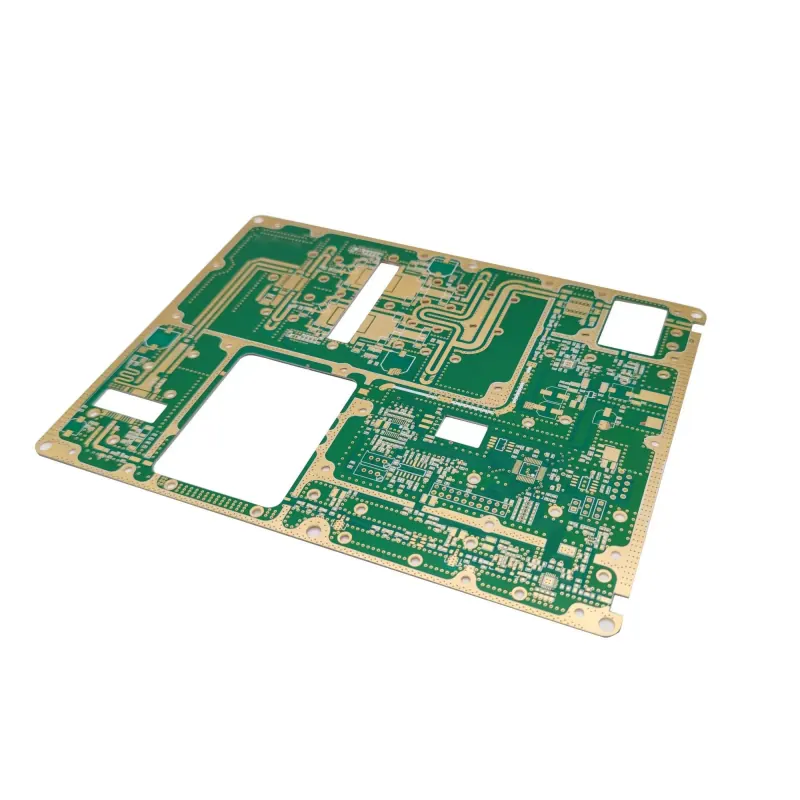
Direct Answer
Choose FR4 when cost, availability, and general digital performance are enough. Choose Rogers 4350B when RF loss, dielectric control, impedance repeatability, or microwave behavior controls the design.
Engineering Context
FR4 and Rogers 4350B are not interchangeable labels on a quote form. They change the process risk, the inspection conversation, and the assumptions the assembler has to accept before release.
The first-principles question is not which option is more popular. The question is which option removes the limiting risk in this board: pad condition, storage window, component pitch, inspection access, material behavior, process capability, or drawing control.
Keep the decision bounded to the released design package. If the drawing, BOM, fabrication notes, or assembler requirements do not state the controlling assumption, the quote should treat the choice as unresolved rather than silently substitutable.
Decision Criteria
- engineering fit
- risk trigger
- RFQ handoff
Comparison Table
| Criterion | FR4 | Rogers 4350B | Decision note |
|---|---|---|---|
| Best fit | the board is general digital, control, or moderate-power hardware without RF loss sensitivity. | RF loss, dielectric stability, or microwave impedance repeatability drives the design. | Choose the option that removes a real build risk. |
| Main limitation | generic FR4 language does not define exact Dk, loss, Tg, thickness tolerance, or reliability margin. | higher material cost, sourcing review, and tighter stackup communication. | Neither side is universally better. |
| RFQ input | state FR4 class, Tg expectation, copper, thickness, and impedance needs. | state laminate family, stackup, impedance targets, RF launch notes, and allowed alternatives. | Make the selected assumption explicit. |
Decision Tree
1. If the decision is controlled by engineering fit, compare the smallest component, fastest signal, or most restrictive inspection requirement first. 2. If FR4 removes that risk, specify it directly in the drawing or RFQ. 3. If Rogers 4350B meets the same electrical, assembly, inspection, and schedule constraints with less complexity, keep the simpler option. 4. If the answer depends on missing stackup, BOM, finish, or inspection data, keep the page as a decision guide and close the RFQ inputs before release.
What Changes The Decision
Use FR4 when the board risk is controlled by the conditions listed in the FR4 column and the added control is justified by assembly yield, electrical behavior, inspection, reliability, or storage margin.
Use Rogers 4350B only when the Rogers 4350B column remains true after checking component geometry, process assumptions, drawing notes, and assembler acceptance.
Do not use this comparison to invent numeric tolerances, thicknesses, shelf-life promises, alloy composition, compliance statements, or supplier capability claims. Those belong in the released specification, applicable standard, or supplier capability review.
Recommended Use Cases
- Use FR4 for general digital, control, or moderate-power boards without RF loss sensitivity.
- Use Rogers 4350B when RF loss, dielectric stability, or microwave impedance repeatability controls the design.
Limitations
- FR4: generic FR4 language does not define exact Dk, loss, Tg, thickness tolerance, or reliability margin.
- Rogers 4350B: higher material cost, sourcing review, and tighter stackup communication.
RFQ Handoff
Before RFQ, state the selected option, allowed alternates, inspection expectations, and any component packages or performance constraints that make one side unacceptable.
If Rogers 4350B is allowed, confirm that the assembler accepts the actual package mix and process condition. If FR4 is required, state it directly instead of relying on a generic default.
A quote that does not normalize these assumptions is not a comparable quote; it is a different manufacturing condition.
Source Notes
- Rigid laminate and prepreg specification boundary - IPC-4101 base materials standard (standard).
Source fact: IPC-4101 is the source boundary for rigid and multilayer printed-board laminate and prepreg specification context. Omini interpretation: Use this to explain why material language should name laminate class, grade, Tg, loss, thickness, and accepted alternatives when those assumptions affect design risk. Allowed usage: Use on FR4, material comparison, stackup, and laminate-related pSEO pages.
- Grade-specific FR4 example - Isola FR406 laminate and prepreg (manufacturer).
Source fact: Isola FR406 is a manufacturer-specific laminate and prepreg example showing that FR4-class materials are grade-specific products. Omini interpretation: Use this to explain why generic FR4 is not enough when Tg, dielectric behavior, loss, thickness tolerance, or approved material lists matter. Allowed usage: Use on FR4 entity, FR4 questions, and material comparison pages.
- RO4350B RF laminate positioning - RO4350B laminates (manufacturer).
Source fact: Rogers positions RO4350B as a high-frequency laminate family for applications where RF behavior and controlled dielectric properties matter. Omini interpretation: Use this to justify Rogers 4350B pages only when RF loss, dielectric repeatability, impedance control, or microwave behavior changes the design decision. Allowed usage: Use on Rogers 4350B entity, FR4 versus Rogers comparison, RF PCB, and impedance pages.
- High-speed routing and impedance context - High-Speed Layout Guidelines (semiconductor_vendor).
Source fact: TI high-speed layout guidance ties signal behavior to stackup, routing geometry, reference planes, impedance control, and return-current continuity. Omini interpretation: Use this to keep impedance and high-speed pages grounded in stackup data, not trace width alone. Allowed usage: Use when explaining controlled impedance inputs, 2-layer versus 4-layer tradeoffs, RF laminate decisions, and high-speed RFQ handoff data.
- Existing OminiPCB repository content (internal): May seed structure and internal links; engineering claims still need external verification when specifications are involved.
This page stores original engineering guidance only. It does not reproduce paid standard text, datasheet tables, competitor claims, prices, or certification claims.
CTA
Request a PCB quote when the selected material, finish, stackup, inspection scope, quantity, and lead time are ready for engineering review.