
Direct Answer
Choosing the best electronic manufacturing services (EMS) partner requires evaluating design-for-manufacturability (DFM) feedback, technical assembly capabilities, supply chain strength, and quality systems—not just comparing unit prices. The right provider catches stackup, component, and inspection issues before production, directly reducing rework and field failures. Start with a complete RFQ containing Gerbers, BOM, and quality standards, then verify the factory's equipment and process controls against your specific package types and volume requirements.
Why the EMS Decision Is an Engineering Choice, Not a Procurement Task
Many engineering teams treat supplier selection as a purchasing function, but the EMS provider's capabilities directly determine whether your design survives contact with production. A factory that only assembles boards without reviewing your design will pass along manufacturability problems that become your cost overruns and warranty claims.
The core issue is that PCB fabrication and assembly involve dozens of variables that interact unpredictably: solder paste selection, reflow thermal profiles, laminate moisture absorption, and component tolerances. A partner that understands these interactions can flag risks during design review. One that does not will simply build what you send, even when the design has obvious production flaws.
This is why the evaluation process must start with engineering criteria. Before discussing price or lead time, you need to confirm the provider can actually build your board to the required quality level. The sections below outline the specific technical, process, and supply chain factors that separate a true manufacturing partner from a passive assembler.
Evaluating DFM Capability Before You Send Files
The first and most valuable test of an EMS provider is their DFM process. A strong DFM review examines your Gerber files, board stackup, and BOM for issues that will cause assembly failures or long-term reliability problems.
What a Proper DFM Review Should Cover
When you send your design package, the provider should return a structured DFM report that addresses:
- Stackup verification: Confirm the laminate type, copper weight, and total board thickness match your mechanical enclosure and thermal requirements. For example, a 1.6 mm FR-4 stackup with 1 oz copper may be fine for standard SMT, but if you are using flexible polyimide for a wearable, the material behavior changes entirely.
- Annular ring and pad geometry: Check that through-hole pads have sufficient copper area around the hole to form a reliable solder fillet. Insufficient annular ring is a common cause of tombstoning in through-hole components.
- Component-to-board fit: Verify that the footprint of each component matches the pad geometry, especially for fine-pitch BGAs below 0.5 mm pitch where solder mask definition and copper thickness become critical.
- BOM component status: Flag any parts that are end-of-life, have long lead times, or are single-sourced without an approved alternate.
A provider that asks these questions before quoting is demonstrating real engineering capability. A provider that only asks for the files and returns a price is not.
The Cost of Skipping DFM
Skipping DFM review does not save time. It moves the discovery of design issues to the build phase, where they cost more to fix. A missing annular ring on a through-hole component might not appear until after the first assembly run, when you see tombstoning under X-ray inspection. At that point, you are paying for rework, new boards, and schedule delays.
The practical rule is to involve the manufacturer during design review, not after the design is frozen. Send your stackup and BOM early, even before the layout is final, to get feedback on the highest-risk items.
Verifying Technical Capabilities Against Your Package Types
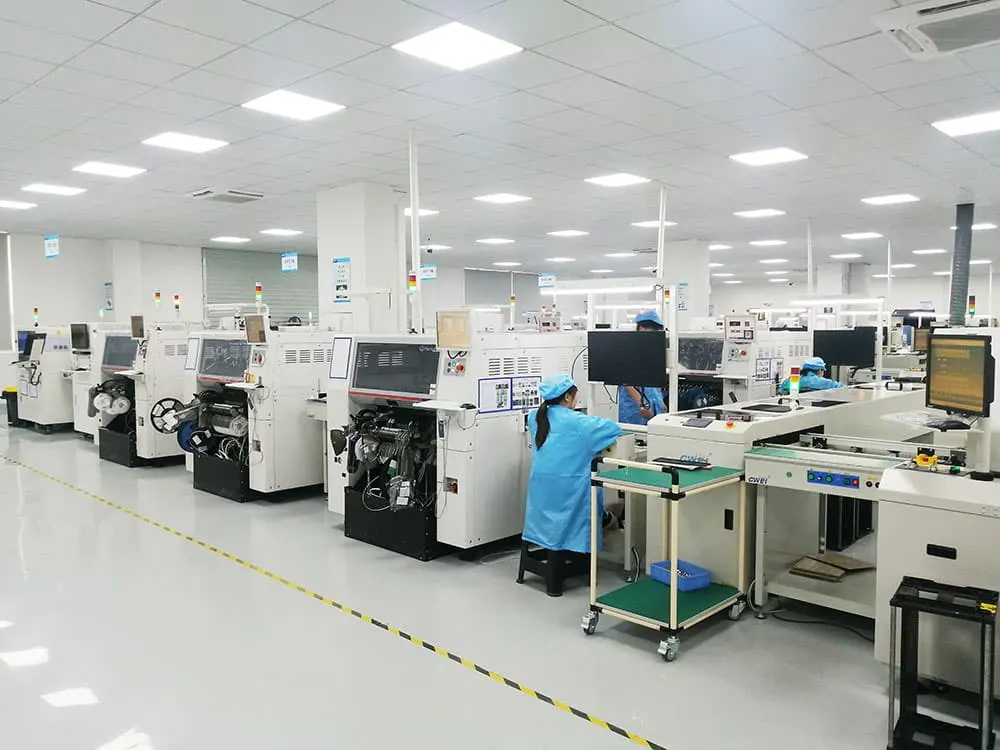
Not all SMT lines are equal. The equipment, inspection methods, and operator experience at a factory determine whether your specific components will be assembled reliably.
Equipment and Process Checks
Before committing, verify the following against your bill of materials:
| Capability | What to Check | Why It Matters |
|---|---|---|
| SMT line precision | Minimum component size and pitch the line can handle | Fine-pitch BGAs below 0.3 mm pitch require precise solder paste application and placement |
| Reflow oven profile control | Number of zones and temperature uniformity | A poor thermal profile causes solder joint voids and warpage on multilayer boards |
| AOI (Automated Optical Inspection) | Coverage of solder joints and component presence | Catches missing or misaligned components before they are buried under other parts |
| X-ray inspection | Ability to inspect BGA and through-hole solder joints | Required for hidden solder joints that AOI cannot see, such as BGA package centers |
| Through-hole assembly capability | Manual or semi-automated stations for through-hole components | Through-hole parts need proper fixturing to prevent movement during reflow |
Matching Experience to Your Product Type
Ask the provider about their experience with your specific package types and industry. A factory that primarily builds single-sided, through-hole boards may not have the process maturity for double-sided, fine-pitch BGA assemblies. Similarly, if you are building flexible LED PCBs, the material handling and assembly process differ from rigid boards. The provider should demonstrate that they understand the material behavior, not just claim general capability.
For flexible PCB assembly, the choice of substrate material directly affects the assembly process. Polyimide and PET films have different thermal expansion and moisture absorption characteristics, which influence solder joint reliability. A provider with experience in this area will know how to adjust reflow profiles and handling procedures accordingly.
Assessing Supply Chain Strength and Component Sourcing
Your EMS provider's supply chain is your supply chain. If they cannot source components reliably, your product will not ship on time, regardless of how well the boards are assembled.
AVL Management and Component Lifecycle
A strong EMS partner maintains an Approved Vendor List (AVL) that includes multiple sources for critical components. They actively monitor component lifecycle status and will alert you when a part is approaching end-of-life or facing allocation issues.
This matters because component obsolescence is a leading cause of redesign. If your BOM specifies a microcontroller that is being discontinued, the provider should flag it during DFM review and suggest an alternative that is already qualified. Without this oversight, you may discover the issue only when the component becomes unavailable, forcing an emergency redesign.
Substitution Approval and Traceability
When a component is unavailable, the provider should not substitute parts without your approval. The substitution process should include:
- A formal change request with the alternative part number and specifications
- Verification that the substitute meets your electrical and mechanical requirements
- Documentation of the change in the build record for traceability
This level of control is essential for regulated industries and for any product where field reliability is critical. A provider that substitutes parts without approval is a liability.
Building a Complete RFQ to Get Accurate Quotes
The quality of your quote depends directly on the quality of your RFQ. An incomplete RFQ forces the provider to make assumptions, which leads to inaccurate pricing and surprises later.
Required RFQ Contents
Your RFQ should include:
- Complete Gerber files: All layers, including copper, solder mask, silkscreen, and drill files
- BOM with manufacturer part numbers: Not just descriptions, but actual part numbers and manufacturers
- Approved Vendor List (AVL): If you have preferred sources, include them
- Board stackup specification: Laminate type, copper weight, total thickness, and surface finish
- Assembly standards: Reference IPC-A-610 for workmanship and J-STD-001 for soldering requirements
- Special process requirements: Any unique needs such as conformal coating, potting, or specific test fixtures
- Volume and lead time expectations: Annual volume and target production start date
- Testing and inspection requirements: Functional tests, burn-in, or specific inspection methods
The Cost of an Incomplete RFQ
An incomplete RFQ often results in a quote that looks attractive but omits necessary work. For example, if you do not specify that your board requires X-ray inspection for BGA joints, the provider may quote only AOI inspection. When you later require X-ray, the cost increases and the schedule slips.
Similarly, if you do not specify the target copper weight, the provider may quote a standard 1 oz copper that is insufficient for your current-carrying traces. The resulting boards may overheat in the field, causing failures that are expensive to recall.
Common Mistakes Engineers Make When Selecting an EMS Partner
Understanding where others fail helps you avoid the same traps. The most common mistakes are:
- Focusing only on unit price: The lowest quote often comes from a provider with weaker process controls or less experience. The total cost includes rework, field failures, and schedule delays.
- Sending a BOM without checking component availability: A BOM with obsolete or long-lead components will delay the build. The provider should flag this, but you should also check before sending.
- Assuming all SMT lines handle all package types: Fine-pitch BGAs, through-hole components, and flexible substrates each require specific equipment and experience. Verify the provider's capability against your actual BOM.
- Skipping the DFM review: The DFM report is your best opportunity to catch design issues before they become production problems. Skipping it saves days but can cost months.
- Not verifying inspection capabilities: If your board has hidden solder joints, such as BGA packages, the provider must have X-ray inspection. AOI alone cannot see these joints.
How to Verify a Manufacturer's Capability Before Production
Before you commit, take the following verification steps:
1. Request a sample DFM report: Ask the provider to perform a DFM review on one of your existing designs. The quality of the report tells you a lot about their engineering depth. 2. Conduct a site audit: Visit the factory and check the equipment, inspection stations, and quality documentation. Look for evidence of process control, such as reflow profile logs and AOI calibration records. 3. Ask for references and case studies: Speak with other customers who build similar products. Ask about their experience with DFM feedback, component sourcing, and quality issues. 4. Verify quality certifications: Confirm that the provider holds relevant certifications for your industry. The scope of the certification matters more than the certificate itself. 5. Review their NPI process: A structured New Product Introduction (NPI) process indicates that the provider has a repeatable method for bringing new designs into production.
For a deeper look at the selection process, see How to Find the Right Electronic Manufacturing Service Provider for Your Project and How to Select a Reliable EMS Factory for Your Electronic Device.
Practical Example: A Fine-Pitch BGA Assembly Decision
Consider a design that uses a 0.4 mm pitch BGA microcontroller on a 1.6 mm FR-4 board with 1 oz copper. The board also has several through-hole connectors that must be soldered on the same side as the BGA.
The DFM review should flag several issues:
- The 0.4 mm pitch BGA requires precise solder paste application. The provider must have an SMT line capable of this pitch and an X-ray inspection system to verify the hidden solder joints.
- The through-hole connectors need sufficient annular ring to form a reliable fillet. If the pad is too small, the connector will tombstone, creating a weak joint.
- The reflow profile must accommodate both the BGA and the through-hole connectors. The thermal mass of the connectors is different from the BGA, so the profile must be tuned to avoid overheating one while underheating the other.
A provider with experience in mixed-technology boards will know how to handle these conflicting requirements. A provider without that experience may produce boards that pass initial inspection but fail in the field due to cracked solder joints or voids.
The Value of a Partner, Not Just a Supplier
The distinction between a supplier and a partner is most visible in how the provider handles design feedback and supply chain issues. A supplier builds what you send. A partner works with you to improve the design for manufacturability, testability, and reliability.
This collaboration shows up in specific ways:
- Design for testability: The provider suggests adding test points or boundary scan access to make functional testing easier and more complete.
- Component substitution recommendations: When a component is at risk, the provider suggests an alternative that is already qualified and available.
- Process adjustments: The provider recommends a different surface finish or laminate to improve solder joint reliability or reduce warpage.
For example, a provider might suggest changing from a standard FR-4 to a low-thermal-expansion laminate for a board with large, dense BGA arrays. This change reduces the risk of solder joint cracking during thermal cycling, improving field reliability.
This kind of collaboration is especially important for complex or high-reliability products. If you are building a flexible LED PCB, the material selection directly affects the assembly process and the final product's durability. See How to Choose the Right Material for Your Flexible LED PCBs for guidance on that specific decision.
When to Involve the Manufacturer in Your Design Process
The best time to involve your EMS partner is during the design phase, not after the design is complete. Early involvement allows the provider to:
- Review the stackup before the layout is final, when changes are still inexpensive
- Flag component availability issues before you commit to a BOM
- Suggest design changes that improve manufacturability without compromising performance
- Plan for testability by incorporating test points and access into the layout
For a practical reference on the full manufacturing process, from raw board to finished assembly, see Circuit Board Manufacturing Process: A practical reference for Beginners. Understanding the process helps you ask better questions during the selection and design review phases.
> Practical note: When you receive a DFM report, do not treat it as a rejection of your design. Treat it as a list of risks that need to be resolved. Each item is an opportunity to improve the product before it reaches production, where fixes are far more expensive.
FAQ
Why is choosing the right EMS provider critical for my project's success?
The right EMS provider directly affects your product's manufacturability, reliability, and total cost. A partner with strong DFM feedback can catch design issues before assembly, reducing rework and field failures. For example, a provider that reviews your stackup and BOM early can flag component obsolescence or assembly tolerances that would otherwise delay your launch.
What are the most common mistakes when selecting an electronics manufacturing partner?
Engineers often focus only on price or lead time and overlook the provider's technical capabilities. A common mistake is sending a BOM without checking component availability or lifecycle status. Another is assuming all SMT lines handle fine-pitch BGAs or through-hole components equally well. Always verify the factory's equipment, inspection methods, and experience with your specific package types.
How can I verify a manufacturer's capability before starting production?
Before sending your design, verify the provider's DFM process and ask for a detailed DFM report. Check if they review Gerber files, stackup, and BOM for issues like insufficient annular ring or tombstoning risks. Also confirm their inspection capabilities, such as AOI and X-ray for BGA, and ask about their quality management system. A pre-build design review is the best way to catch problems early.
What information should I include in my RFQ to get an accurate quote?
Your RFQ should include the complete Gerber files, BOM with manufacturer part numbers, approved vendor list (AVL) if available, and any special process requirements. Specify the target copper weight, laminate type, surface finish, and assembly standards like IPC-A-610 or J-STD-001. Also state the expected volume, lead time, and any testing or inspection requirements. The more complete your RFQ, the more accurate the quote and the fewer surprises later.
What value does an EMS partner add beyond just assembling boards?
A true manufacturing partner provides value beyond assembly. They offer DFM feedback, component sourcing support, and supply chain management. They also help with design for testability and reliability. For example, they might suggest a different surface finish to improve solder joint reliability or recommend a more available component to reduce lead time. This collaboration reduces risk and improves your product's overall quality.
How do I evaluate an EMS provider's technical expertise and reliability?
Start by evaluating the provider's technical capabilities against your specific needs. Check their equipment, such as SMT lines, reflow ovens, and inspection tools. Review their experience with your industry and product type. Ask for references or case studies, and verify their quality certifications. Also, consider their supply chain strength and ability to manage component sourcing. A site visit or audit can provide the most confidence. For a focused look at SMT assembly supplier selection, see How to Choose the Right SMT PCB Assembly Supplier for Your Project.
> Engineering handoff note: How to Find the Right Electronic Manufacturing Service Provider for Your Project before the release package is frozen.