
Direct Answer
There is no reliable universal public ENIG price. ENIG usually costs more than HASL or OSP because it adds a controlled nickel-gold finish, but the actual adder depends on exposed copper area, finish specification, panel utilization, order quantity, supplier process control, inspection expectations, lead time, and gold and nickel commodity exposure.
Decision Model
ENIG cost adder = controlled finish process + exposed pad area and panel utilization + supplier chemistry and inspection control + order quantity and lead-time effects + gold and nickel commodity exposure. Use this as an RFQ checklist, not as a public pricing formula.
Why It Matters
Answer ENIG cost as a quote-readiness question without publishing unsupported price ranges. Late discovery changes cost, schedule, yield, or acceptance evidence after engineering and procurement have already made assumptions.
Engineering Principles
- Start from the engineering risk the question is trying to remove, not from a preferred keyword or default process.
- Answer ENIG cost as a quote-readiness question without publishing unsupported price ranges. The answer should change at least one released input, review step, supplier responsibility, inspection scope, or acceptance expectation.
- If the same design files, stackup notes, BOM, inspection scope, and test plan would be sent either way, keep the answer as an FAQ on the closest entity page instead of publishing a standalone question.
Example
A small BGA control board may justify ENIG because pad flatness and storage margin reduce assembly risk; a simple through-hole board assembled immediately may be better quoted with HASL or OSP if those finishes satisfy the drawing and assembler.
Comparison
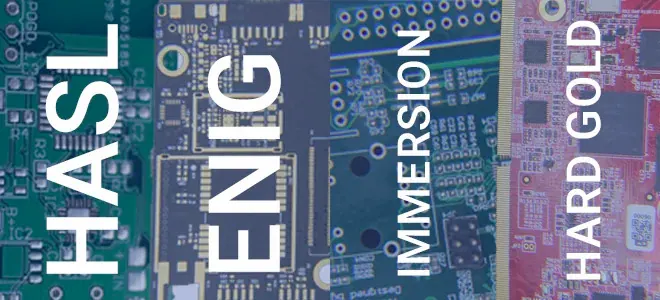
- ENIG: higher finish cost, flatter pads, stronger storage margin, and better fit for BGA, QFN, fine-pitch SMT, or exposed pads that need a controlled surface.
- HASL: often lower finish cost, but pad topography can be a poor fit for fine-pitch or coplanarity-sensitive packages.
- OSP: often low cost and flat, but storage, handling, and assembly-window control become more important.
RFQ Inputs
- State whether ENIG is required or whether HASL, OSP, immersion silver, or another finish is acceptable.
- Send board size, panel constraints, layer count, copper weight, stackup notes, quantity, and target lead time.
- Call out the BGA, QFN, fine-pitch, contact, storage, or inspection reason that makes ENIG worth the extra cost.
- Ask the supplier to quote ENIG as a controlled fabrication process, not as a live commodity-price calculation.
FAQ
Can gold and nickel market prices estimate ENIG cost?
Only as background. Commodity data explains material exposure, but ENIG quote pricing also depends on board geometry, plated area, panelization, quantity, supplier process control, inspection scope, and commercial terms.
When is ENIG worth the added cost?
ENIG is easier to justify when pad flatness, fine-pitch assembly, BGA or QFN coplanarity, longer bare-board storage, or exposed-pad protection reduces manufacturing risk.
Should I choose ENIG by default?
No. Choose ENIG when it removes a real assembly, storage, pad-flatness, or finish-control risk. If HASL or OSP satisfies the released drawing and assembler requirements, ENIG may only add cost.
Source Notes
- ENIG finish specification boundary - IPC-4552 ENIG plating standard (standard).
Source fact: IPC-4552 is the source boundary for electroless nickel immersion gold surface-finish specification context. Omini interpretation: Use this to frame ENIG as a controlled fabrication finish that must be named in drawings and verified by the fabricator. Allowed usage: Use on ENIG entity, finish comparison, and surface-finish decision pages.
- Gold commodity exposure for ENIG cost - USGS Mineral Commodity Summary 2026: Gold (government).
Source fact: USGS publishes public gold commodity summaries that include price and supply context at the commodity level. Omini interpretation: Use this to explain that ENIG has gold exposure, but board-level ENIG cost still depends on finish specification, plated area, panel utilization, supplier process control, quantity, and commercial review. Allowed usage: Use on ENIG cost, surface-finish cost, and RFQ readiness pages when explaining why public commodity data cannot become a universal PCB finish price.
- Nickel commodity exposure for ENIG cost - USGS Mineral Commodity Summary 2026: Nickel (government).
Source fact: USGS publishes public nickel commodity summaries that include price and supply context at the commodity level. Omini interpretation: Use this to explain that ENIG has nickel exposure, while the RFQ cost adder must still be controlled by the PCB finish callout, exposed copper area, supplier capability, inspection expectations, quantity, and lead-time assumptions. Allowed usage: Use on ENIG cost, surface-finish cost, and RFQ readiness pages when explaining material-cost exposure without making an instant quote promise.
- Existing OminiPCB repository content (internal): May seed structure and internal links; engineering claims still need external verification when specifications are involved.
CTA
Request a PCB quote when the design files and acceptance requirements are ready for engineering review.