
Direct Answer
Standard PCBs are pre-fabricated to common footprints and layer counts. They ship fast and cost little per unit. Custom PCBs are engineered to your Gerber, stackup, and performance requirements. They cost more upfront but eliminate the hidden tax of design compromise: signal degradation, thermal issues, assembly headaches, and field failures.
The investment pays off when your product cannot tolerate the constraints of a one-size-fits-all board. That includes high-speed designs, tight mechanical envelopes, rigid-flex assemblies, and anything destined for regulated or high-reliability markets. For a simple LED blinker or early proof-of-concept, standard boards are perfectly rational. For products where failure is expensive, custom is not a luxury—it is risk management.
What "Standard" and "Custom" Actually Mean in Production
A standard PCB is typically a catalog item: fixed dimensions, common layer counts like two or four layers, standard FR-4, and a generic surface finish. You download the Gerber or order from a parametric menu. The factory does not review your schematic. They print what you ordered, not necessarily what your circuit needs.
A custom PCB starts with your design package—Gerber, drill, netlist, stackup requirements, impedance targets, and sometimes the BOM. The fabricator reviews manufacturability, suggests DFM improvements, and builds to your specification. Every parameter from dielectric thickness to copper weight is selectable. This matters because electrical performance is inseparable from physical construction in modern electronics.
The gap widens when you move beyond two-layer boards. Controlled impedance, blind and buried vias, sequential lamination, and mixed-material stackups are not available as standard products. If your design uses DDR memory, RF sections, or high-current paths, the board must be engineered, not picked from a shelf.
Where Custom Boards Deliver Measurable Value
Signal Integrity and Stackup Control
High-speed signals demand precise impedance, which depends on trace geometry, dielectric constant, and layer spacing. Standard boards give you whatever stackup the factory runs that week. Custom boards let you define prepreg and core thicknesses to hit 50-ohm single-ended or 100-ohm differential targets exactly.
Mismatched impedance causes reflections, timing jitter, and EMC failures. Debugging these on a standard board often means scraping the design and starting over. The cost of one respin usually exceeds the premium of building custom from the start.
Thermal and Mechanical Fit
Products with confined enclosures or heat-sensitive components need copper weight, via stitching, and sometimes metal-core or thermally conductive substrates. Standard boards cannot accommodate these without heroic post-assembly modifications. Custom fabrication integrates thermal vias, heavy copper planes, or embedded heatsinks into the bare board.
Mechanical integration suffers similarly. A standard board may require mounting adapters, standoffs, or hand-modification to fit your housing. Custom boards include precise mounting holes, keepout regions, and board profile matching your industrial design. Assembly time drops. Reliability rises.
Rigid-Flex and Complex Form Factors
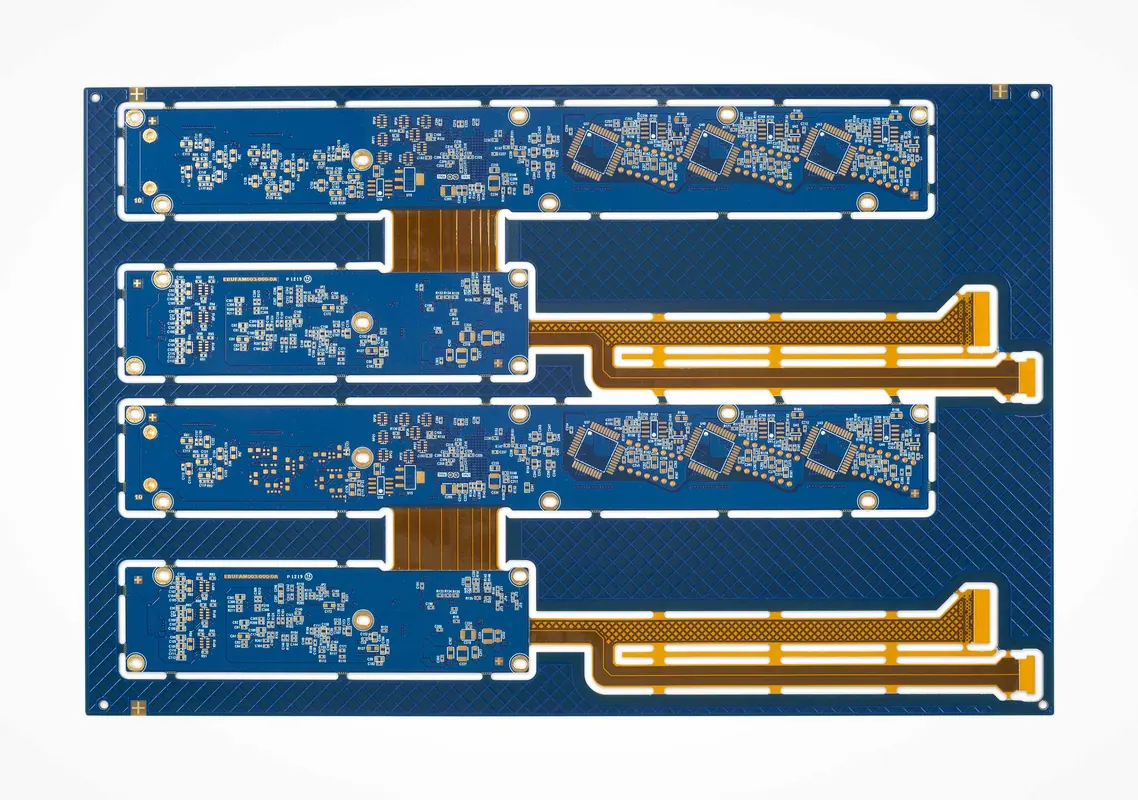
Wearables, medical devices, and aerospace systems often need circuits that bend, fold, or occupy irregular volumes. Rigid-flex PCBs combine rigid sections for component mounting with flexible sections for dynamic or space-constrained interconnections. No standard product offers this. The design requires custom material selection, coverlay definition, and bend radius control.
For teams entering this space, Rigid-Flex PCB DFM Tips Before PCB Manufacturing covers the layout and fabrication checks that prevent delamination and trace cracking. These are not optional details; they determine whether the product survives its first flex cycle or its thousandth.
The Hidden Costs of Standard Boards in Volume
Yield and Rework
Standard boards are not validated against your BOM. A footprint mismatch, pad size issue, or soldermask clearance problem may not surface until SMT setup. At that point, you are debugging on the production line with schedule pressure and hourly labor costs accumulating. Custom DFM review catches pad-to-hole ratios, component spacing, and solder mask defined vs. non-defined pad issues before a single board is fabricated.
Component Sourcing Constraints
Your preferred IC package may require a specific land pattern or via-in-pad configuration that standard boards do not support. Forcing a component onto an incompatible footprint invites tombstoning, voiding, or latent defects. Custom boards accommodate the components you actually source, including fine-pitch QFNs, BGAs, and bottom-terminated packages that dominate modern BOMs.
Long-Term Reliability
Standard boards use generic FR-4 with unverified glass weave and resin systems. For automotive, medical, or industrial applications, this introduces risk. Custom fabrication lets you specify high-Tg laminates, low-Df materials for RF, or halogen-free systems for environmental compliance. The incremental material cost is minor compared to a recall or warranty claim.
If your design pushes current density, Common Failures in Heavy Copper PCB and How to Avoid Them in the Design Stage explains how trace heating, etch uniformity, and thermal cycling interact—considerations that standard boards ignore entirely.
When Standard PCBs Still Make Sense
Not every project justifies custom fabrication. Early prototypes, educational builds, and cost-optimized consumer commodities with loose electrical requirements are valid applications. If the design has no impedance-controlled nets, no thermal challenges, and no mechanical constraints, a standard two-layer board gets you to market faster and cheaper.
The discipline is recognizing when "good enough" stops being true. A team that prototypes on standard boards, then blindly transfers to production without re-evaluating, often inherits a stack of compromises that become expensive to unwind. The transition point from standard to custom should be a deliberate decision, not an accident of schedule pressure.
Evaluating Total Cost of Ownership
Unit price comparisons mislead. The relevant metric is total cost through the product lifecycle, including:
| Cost Category | Standard PCB Risk | Custom PCB Mitigation |
|---|---|---|
| Engineering rework | High; respins for electrical or mechanical fit | Low; DFM review upfront |
| Assembly yield | Variable; footprint and solderability issues | Higher; pad and mask optimized for your BOM |
| Field failures | Elevated; unverified materials and stackup | Lower; specified for operating environment |
| Schedule delay | Common; surprises in prototype or pilot | Reduced; predictable fabrication and assembly |
| Certification | Risk of failure; no material traceability | Supported; controlled laminate and finish documentation |
For organizations scaling from prototype to volume, Comparing the Best PCB Manufacturers: Key Features and Services offers a framework for evaluating partners on capabilities that matter beyond per-unit pricing.
Selecting a Manufacturing Partner for Custom Work
Custom PCB success depends heavily on the fabricator's engineering engagement. The right partner reviews your stackup for manufacturability, flags impedance discontinuities, and confirms material availability before finalizing the job. They do not simply execute your Gerber—they improve it.
Choosing the Right PCB Manufacturer in China: Key Factors to Consider outlines the capabilities, communication practices, and quality systems that separate transactional vendors from true manufacturing partners. Omini functions as an EMS provider that bridges PCB fabrication through final assembly, which matters because custom boards are only as good as the process that assembles them.
Quality Systems and Reliability Assurance
Custom boards enable quality; they do not guarantee it. That requires incoming inspection, process control, and traceability. For products where failure has serious consequences, Custom PCB Board Manufacturer: How to Ensure Quality and Reliability connects fabrication decisions to the broader quality framework that governs high-reliability production.
Surface finish selection illustrates this intersection. ENIG provides flat, solderable pads for fine-pitch work but introduces nickel corrosion risk in certain environments. Immersion silver offers excellent solderability but demands careful handling to prevent tarnish. OSP is economical and planar but has limited shelf life and rework tolerance. Custom fabrication lets you match the finish to your assembly process, end-use environment, and reliability targets—not accept whatever a standard board happens to carry.
Practical Decision Framework
Ask these questions when weighing custom against standard:
- Does the design have controlled impedance or high-speed signals?
- Will the board operate in thermally challenging conditions or confined spaces?
- Is the form factor fixed by industrial design or regulatory enclosure requirements?
- Does the product require rigid-flex, heavy copper, or mixed dielectrics?
- What is the cost of a field failure or production delay relative to the PCB premium?
- Will the product undergo certification that requires material and process traceability?
If you answer yes to more than one of the first four, custom is likely justified. If the fifth or sixth matters to your business model, standard boards introduce unquantified risk.
Final Field Note
The standard vs. custom debate is not about prestige or over-engineering. It is about matching the board to the actual demands of the product and the business. Teams that default to standard boards to save a few dollars per unit often spend multiples of that savings in rework, delayed launches, and damaged reputation. Conversely, teams that specify custom boards for trivial applications waste resources that could go toward features customers actually notice. The skill is knowing which side of the line your project sits on—and being honest about it before the first Gerber ships to the factory.