
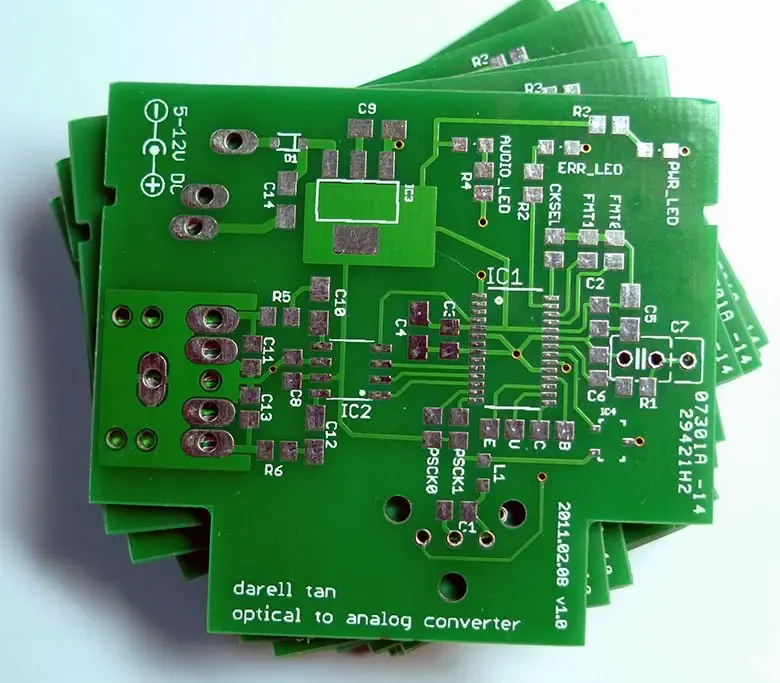
Direct Answer
Use MEGTRON 6 when high-speed digital loss is the limiting problem. It is a low-loss laminate family for boards where serial-link insertion loss, eye margin, via transitions, and dense stackups matter more than simply surviving lead-free assembly.
Specification Snapshot
| Property | MEGTRON 6 model data | Engineering note |
|---|---|---|
| Material family | Low-loss, highly heat-resistant circuit board material | Panasonic MEGTRON 6 variants include R-5775/R-5670 constructions |
| Dk | 3.4 at 1 GHz and 12 GHz | Use final construction for channel simulation |
| Df | 0.002 at 1 GHz, 0.004 at 12 GHz | Suited to high-speed digital loss budgets |
| Tg | 185 C by DSC, 210 C by DMA | Strong thermal robustness for dense multilayer builds |
| Td | 410 C | High decomposition temperature compared with many FR-4 systems |
| T288 | More than 120 minutes with and without copper | Useful for lead-free process margin |
| CTE X/Y, below Tg | 14-16 ppm/C | Good dimensional stability |
| CTE Z, below Tg | 45 ppm/C | Review via reliability with actual stackup |
| Water absorption | 0.14 percent | Helps humidity-related stability assessment |
Why Engineers Choose MEGTRON 6
The first-order problem is channel loss. In high-speed digital boards, the material affects insertion loss, dielectric loss, propagation delay, skew, and margin at the receiver. A standard FR-4 stackup can pass at lower speeds but fail once trace length, connector loss, via transitions, and equalization limits are included.
MEGTRON 6 is chosen when simulation shows the channel needs a lower-loss dielectric while still supporting dense multilayer fabrication. The decision should be driven by measured or simulated channel requirements, not by a generic "high speed" label.
Where MEGTRON 6 Fits Best
MEGTRON 6 is a strong candidate for:
- Switches, routers, and telecom line cards
- Server, storage, and accelerator boards
- Backplanes and daughtercards with long serial links
- Dense multilayer boards with controlled impedance and tight loss budgets
- Designs where FR-4 loss forces excessive equalization or reduces eye margin
It is usually unnecessary for low-speed industrial controls, simple power boards, or RF antenna tuning problems. For RF/microwave boards, compare Rogers RO4003C or RO4350B first.
Stackup and Fabrication Notes
Specify the exact MEGTRON 6 variant and construction. The fabricator needs dielectric thicknesses, copper foil roughness, copper weight, impedance targets, reference-plane assignments, and insertion-loss expectations. For high-speed links, the loss model should include dielectric loss, conductor roughness, via stubs, connectors, and return-path discontinuities.
Backdrilling, via-in-pad, sequential lamination, and high layer counts can all interact with the material decision. A low-loss laminate does not fix a poor via transition or a broken reference plane.
For quote-package readiness, use the MEGTRON 6 PCB Manufacturing checklist to separate material approval, stackup release, sourcing risk, impedance evidence, and allowed alternates before fabrication.
Worked Example
A networking board routes multiple long differential pairs between a switch ASIC and optical module cages. With high-Tg FR-4, the pre-layout channel model requires aggressive equalization and leaves little eye margin. Moving the high-speed layers to MEGTRON 6 reduces dielectric loss and gives the designer more margin, but only if the stackup also controls copper roughness, via stubs, and connector transitions.
If the same product has only short low-speed control routes, MEGTRON 6 would add cost without solving the real constraint.
Comparison
| Material | Best use | Main tradeoff |
|---|---|---|
| MEGTRON 6 | High-speed digital channels and dense low-loss multilayers | Specialty material cost and availability planning |
| Isola 370HR | High-reliability FR-4-class lead-free builds | Standard-loss dielectric behavior |
| FR4 Tg170 | Cost-controlled thermal upgrade from standard FR-4 | Broad category unless exact grade is specified |
| RO4350B | RF and microwave boards needing UL 94 V-0 | RF-focused material, not the default for digital backplanes |
| RO4003C | Cost-sensitive RF/microwave boards | Not UL 94 V-0 rated |
Datasheet References
Summary
MEGTRON 6 is a channel-margin material. Choose it when high-speed simulation, connector loss, trace length, and receiver margin show that standard FR-4 or ordinary high-Tg FR-4 is not enough. The final release must lock the exact construction and fabrication controls, because material choice alone cannot rescue a weak high-speed stackup.